



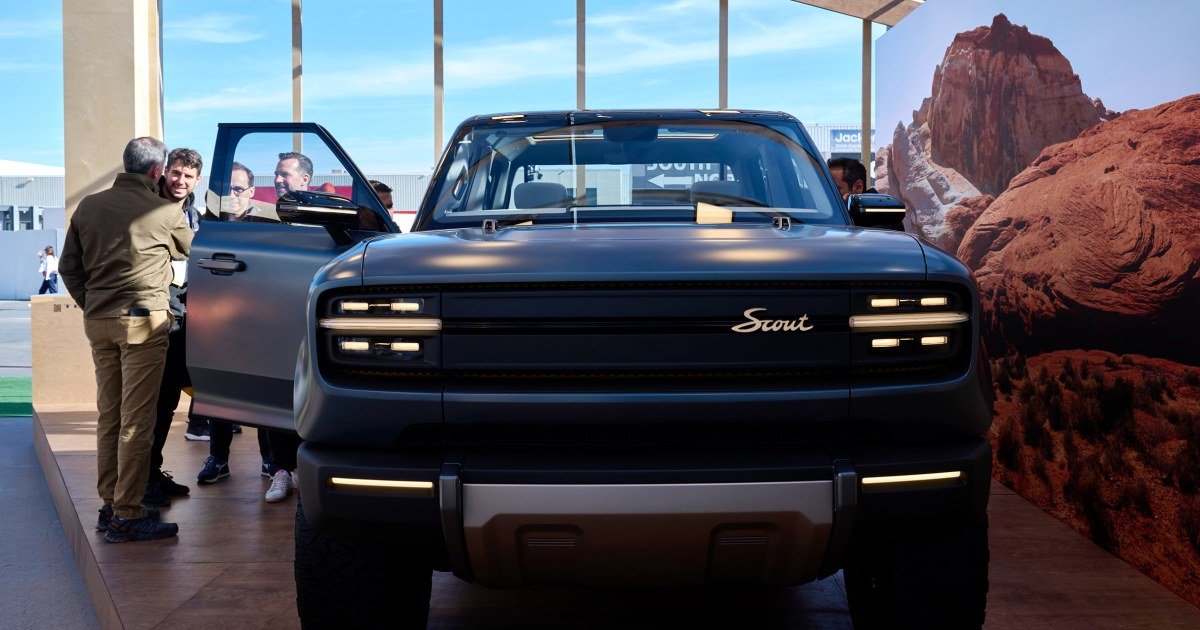
LAS VEGAS – Scout Motors has received more than 50,000 refundable reservation deposits for its first electric pickup trucks and SUVs, according to Volkswagen CEO Oliver Blume.
Volkswagen revived Scout, which was an American brand from 1961 to 1980, and revealed intended production vehicles for its Terra pickup truck and Traveler SUV in October. The vehicles will be offered as all-electric models or extended range electric vehicles, or EREVs.
Scout has received fewer reservations than other automakers for all-electric vehicles in the early 2020s, when many were first being introduced. Reservations do not guarantee sales but can be a barometer of interest.
“The market response has been very, very positive,” Blume said Tuesday night during a private media event at the CES technology conference in Las Vegas. “The answer was ‘This is heritage.’ … It’s kind of a love story.”
In the case of Scout, customers must submit a $100 refundable deposit to be among the first to place an order for a vehicle when it opens. The vehicles are scheduled to arrive in 2027.
The Scout brand is part of VW’s plan to increase its market share in the United States through its brands, which include Audi, Porsche and its namesake brand, among others. The German automaker’s U.S. share currently stands at around 4%, Blume said.
“Our ambition is much higher to improve our market share, and we think we have some potential with all the new cars coming into the market,” Blume said, without disclosing a potential market share target.
Scout CEO Scott Keogh said during a separate interview at CES that bookings exceeded the company’s expectations. He said around 70% of bookings have been for the Traveler SUV, in line with the company’s expectations.
Keogh declined to reveal the breakdown between bookings for the all-electric and EREV models.
“We’re very happy with the numbers,” Keogh told CNBC. “There has been a good reaction to the EREV.”
EREVs are basically a type of plug-in hybrid electric vehicle. They include electric vehicle motors and battery cells, as well as a traditional internal combustion engine to power the vehicle’s electrical components when the battery loses power. Basically, the motor acts as a generator to power the electric vehicle components when needed.
Keogh previously said Scout added EREV to better protect the brand from any market volatility amid lower-than-expected consumer demand for electric vehicles.
He said the company is currently focusing on three primary missions: increasing brand recognition, continuing vehicle engineering and completing a $2 billion factory in South Carolina.
Both the Traveler and Terra are expected to start at less than $60,000, according to Scout’s website. EREV vehicles will feature more than 500 miles of range, according to the company, with up to 350 miles of range for all-electric models.
At CES, Scout highlighted the connectivity and in-vehicle user experiences of its upcoming trucks and SUVs, which are designed to be outdoor recreational models similar to Jeep and electric vehicle startup Rivian. That includes available satellite connectivity for Scout vehicles in remote areas.
Scout is currently building a plant in South Carolina with an annual production capacity of 200,000 vehicles. Scout hopes to use batteries, the most expensive part of an electric vehicle, from a battery cell manufacturer at a VW joint venture in Canada.
Scout also plans to use software and electrical architecture from a $5.8 billion joint venture between Rivian and VW in its vehicles.
VW acquired the Scout brand and name following global conglomerate’s acquisition of Navistar, a successor to Scout’s original owner International Harvester, for $3.7 billion in 2021.