




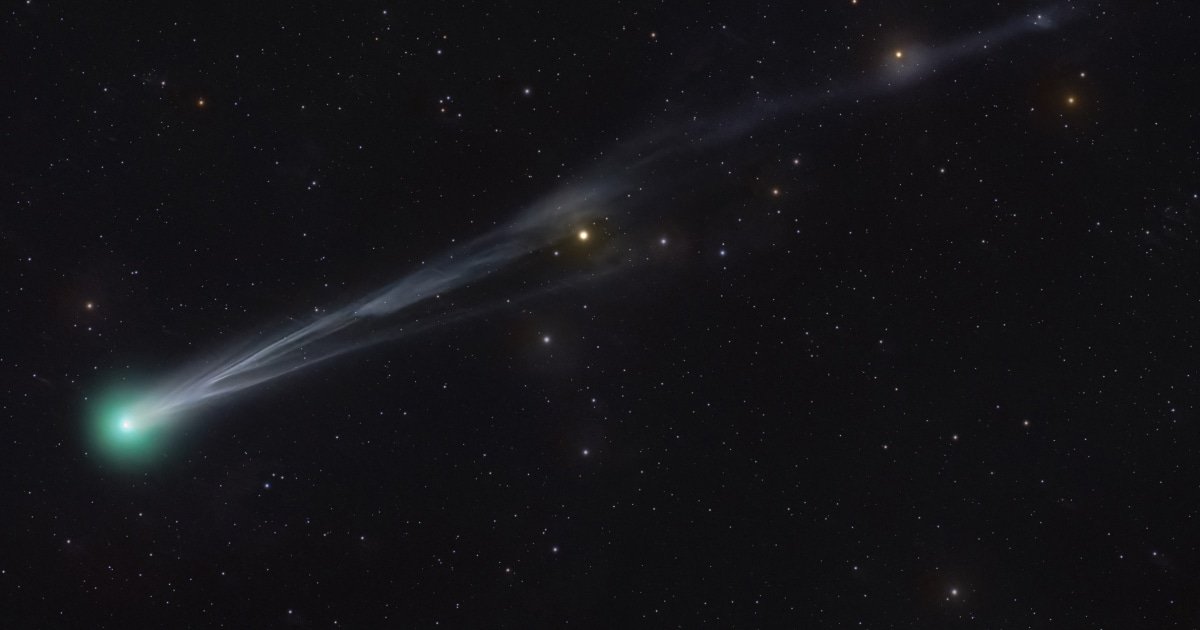
Two greenish-hued comets will pass through the inner solar system this fall, offering a rare opportunity to spot them in the coming weeks.
The comets, named C/2025 A6 (Lemmon) and C/2025 R2 (SWAN), are now visible from the Northern Hemisphere as their orbits take them through our cosmic backyard on their journey around the sun.
Two comet appearances in the same month are very rare.
Both celestial objects can be seen with binoculars or small telescopes until the end of October. Comet Lemmon may be visible to the naked eye when it reaches its closest point to Earth, and therefore its brightest point will be on or around October 21.
Some skywatchers have already seen these icy travelers.
Astrophotographer Julien De Winter, a junior professor at the University of Mons in Belgium, photographed Comet Lemmon in late September from Texas, capturing its spectacular emerald glow and long tail.
The faint green color comes from the presence of carbon in the gas cloud surrounding the comet’s nucleus.
In the northern hemisphere, from now until the middle of the month, Comet Lemmon will appear near the Big Dipper before the sun rises, according to EarthSky, a website dedicated to sky watching and astronomy. It is best to look northeast in the sky in the pre-dawn hours, slightly below the group of stars that form the distinctive bowl and handle of the Big Dipper.
In about a week, the comet will be visible in the night sky, rising in the west. From then until the end of the month, it may be possible to see it with the naked eye, but these cosmic objects may be difficult to see.
Comet SWAN will be visible in the night sky until the end of the month. The best time to observe it will be approximately 90 minutes after sunset, looking southwest. This comet is likely not bright enough to see with the naked eye, so binoculars or a small telescope will be necessary.
In the coming days, Comet SWAN will appear higher and higher on the horizon after sunset and may become brighter before reaching its closest point to Earth around October 20.
Under ideal conditions (clear weather, dark skies, and as little light pollution as possible), it might even be possible to see both comets on the same night, toward the end of the month.
Comet Lemmon was discovered in January by the Mount Lemmon Survey, which tracks near-Earth objects using telescopes located in the Santa Catalina Mountains in Arizona.
The discovery of Comet SWAN was even more recent: An amateur astronomer spotted it in early September while examining images from the SWAN instrument at NASA’s Solar and Heliospheric Observatory, which launched in 1995 on a mission to orbit and study the sun.
A different type of comet, one from outside our solar system, will also pass by the inner solar system this month. Comet 3I/ATLAS is only the third interstellar visitor ever confirmed and was recently imaged by a spacecraft orbiting Mars. The interstellar comet will get closer to the sun around October 30.