



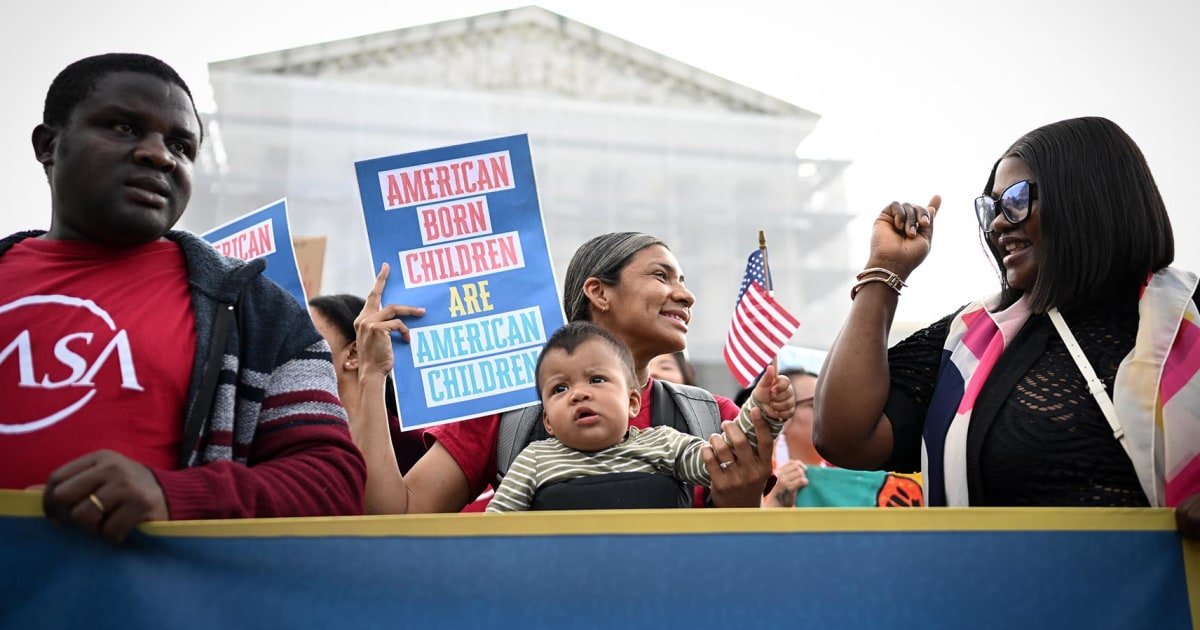
WASHINGTON – In a blockbuster ruling, the Supreme Court agreed Friday to decide the legality of President Donald Trump’s controversial plan to reverse automatic birthright citizenship for almost anyone born in the United States.
The eventual ruling in a New Hampshire case, expected in late June, will likely conclusively determine whether Trump’s ambitious proposal can move forward.
The case sets up a major clash between a president whose aggressive use of executive power has been a defining feature of his second term and a court with a 6-3 conservative majority that has so far largely avoided direct confrontations with the White House.
Birthright citizenship has long been understood to be a requirement under the 14th Amendment to the Constitution, which states: “All persons born or naturalized in the United States, and subject to the jurisdiction thereof, are citizens of the United States.”
The language was included in the constitutional amendment enacted after the Civil War to ensure that former black slaves and their children were recognized as citizens.
Jurists of all ideological stripes have generally assumed that the phrase is self-explanatory, with the only exceptions being people born to foreign diplomats, hostile invading forces, and members of some Native American tribes.
But Trump, as part of his crackdown on immigration, has sought to unravel that historical understanding, adopting a hitherto marginal theory pushed by anti-immigration activists.
Under the administration’s view, birthright citizenship would be limited to those who have at least one parent who is a U.S. citizen or legal permanent resident. In that scenario, the right would not apply to babies born to temporary visitors who entered the country legally or to people who entered the country illegally.
The administration’s legal argument, presented by Attorney General D. John Sauer, is that the “subject to its jurisdiction” language confers citizenship on only children who are not only present in the United States but also loyal to that country.
It is not enough to simply be subject to US law, which is how the clause has traditionally been interpreted, he maintains.
“However, long after the adoption of the Clause, the erroneous view that birth on U.S. soil confers citizenship on any person subject to the regulatory reach of U.S. law became widespread, with destructive consequences,” Sauer wrote in court papers.
Trump’s executive order is an effort to “restore the original meaning of the Clause,” he added.
The case involves individual plaintiffs represented by the American Civil Liberties Union. Among the plaintiffs, who use pseudonyms, are two babies who would be subject to the order.
Trump’s executive order is “completely contrary to the constitutional text, the precedents of this court, the dictates of Congress, the long-standing practice of the Executive Branch, academic consensus, and more than a century of our nation’s daily practice,” lawyers for the challengers wrote in court documents.
They point to an 1898 case, called United States v. Wong Kim Ark, in which the Supreme Court ruled that a man born in San Francisco to parents who were both Chinese was an American citizen.
Announced on Trump’s first day in office, Jan. 20, the policy has fared poorly in lower courts, with judges across the country ruling it illegal, as they did in the New Hampshire case. As a result, the plan has not been implemented.
The Trump administration already got the Supreme Court to intervene when it successfully argued that individual judges did not have the authority to block the plan nationwide. However, that decision did not affect the legal merits of the executive order.
The court did not act on a separate case involving a lawsuit brought by the states of Washington, Arizona, Illinois and Oregon.
The Supreme Court has generally been receptive to the Trump administration in cases brought this year, but many legal observers believe the fight over birthright citizenship may be an exception.
Now important evidence of Trump’s executive power is mounting in court. A ruling on the president’s extensive use of tariffs is due any day now, while the justices are also set to weigh in on his authority to fire members of executive government entities, including the Federal Reserve, in the coming months.