


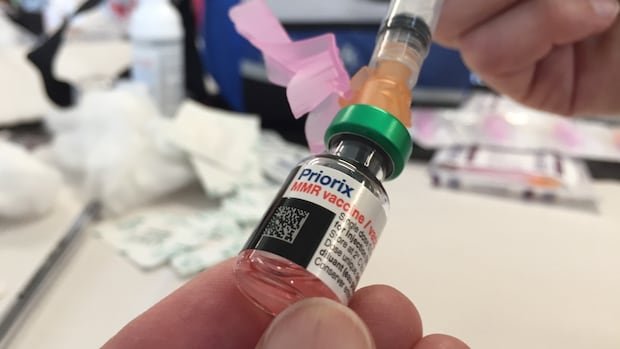
Measles is returning in Quebec. From December to March, at least 31 cases were reported and experts indicate a cause: decrease vaccination rates.
“The unifying issue for all these places on why measles is causing outbreaks or is out of control is very simple: low vaccination rates,” said Dr. Donald Vinh, a specialist in infectious diseases at the health center of the University of McGill (MUHC).
Quebec’s public health data, obtained by Radio-Canada, show that vaccination rates decreased during COVID-19 pandemic.
“It is true that during the pandemic, there were difficulties in access. And access is really the key to making vaccination as easy as possible for parents,” said Dr. Nicholas Brousseau, a doctor from the Institut National de Santé Publique du Québec (INSPQ).
Montreal has the lowest vaccination rate in the province with 85 percent pre-pandemic and 83 percent in 2024.
Experts say that the lack of access to the vaccine during the pandemic played a role in the vaccination rates observed in the province today.
A strong drop in vaccination rates occurred around 2021-22 in many areas during pandemic, particularly in Montreal with 79.2 percent and Laurentians with 84.6 percent.
The Laurentians and the Montérégie region have continued to have low vaccine rates, despite a recent increase.
In Nunavik, rates fluctuate, but are currently strong. The rate increased from 74.4 percent in 2015-16 to more than 97 percent in recent years, according to Quebec vaccination record data.
Lack of attributed vaccination access
“It is not that people are against the vaccine, it is that people do not have access,” Vinh said.
Measles spread through the respiratory tract and can be fatal, particularly for babies and those who are pregnant or have weakened immune systems.
Children generally receive the vaccine at 12 and 18 months, but remains available for free at any age. Experts warn that 95 percent vaccination coverage is needed to prevent outbreaks.
“Eighty-three, 89-All these values may seem good on paper, but it is not at least 95 percent, and that is why you are receiving all these outbreaks,” Vinh explained.
Trying to increase vaccination rates is a continuous effort in every Quebec.
“We always have to maintain those efforts because measles is so contagious that when more and more children are not vaccinated, the transmission can start over,” Brousseau said.
Experts say that school -based vaccination programs are key.
Possible exhibition at Bell Center in Montreal
On Monday, Montreal Health officials announced measles exposure at the Bell Center on March 3 between 5:30 pm and midnight.
That was the night the Montreal Canadiens defeated the Buffalo Sabres in extra time. An individual not vaccinated with measles attended the game during the contagious period of the virus, according to a press release from the Ciusss du Center-Sud-de-L’île-de-Montréal.
Anyone who attended the party could have been exposed, says the statement. But there is a particular concern for the spectators who sat in the red sections 111 to 117, and the staff of Tim Hortons and Pizza Pizza.
You can be more information about the possible exhibition Found here.
Beyond tracking these possible outbreaks, officials urge anyone backward to their vaccines to reserve an appointment through CLICENA Santé or visit their local CLSC.
The province’s health network confirmed 30 cases as part of the last outbreak, arriving at a time when there are shoots throughout the country.
Laurentians remain the most affected region, with 27 measles cases. The other cases are found in Montreal, Laval and the Montérégie. This recent outbreak dates back to December and remains active, said Santé Québec.
“This potentially serious disease is very contagious,” he says on his website, citing dozens of locations and times of people that people may have been exposed to the virus.