



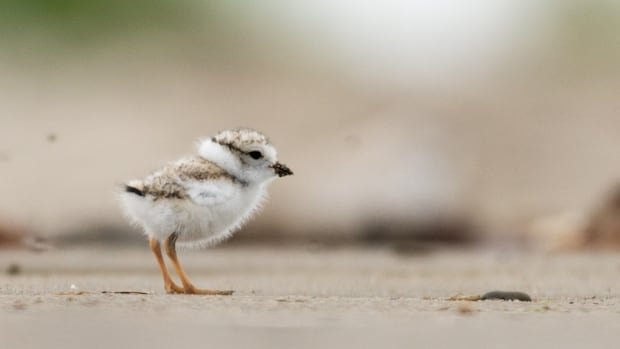
Kouchibouguac National Park welcomed six pairs of plovers in 2024, resulting in 16 chicks, the highest annual production in seven years.
But it’s just a small step in the fight to conserve endangered species.
Plovers are migratory shorebirds that stop along the eastern coasts of North America each spring to nest and raise their young before making their journey south to Florida or the Caribbean.
The species is vulnerable to predation, flooding and human activity because the birds build their nests on exposed sandy beaches.
“It’s significant because we monitor the reproductive success of plovers and 16 chicks from six pairs of plovers is equivalent to 2.67 in terms of breeding rate,” said Daniel Gallant, an ecologist with Parks Canada.
Canada’s national recovery strategy targets a production rate of 1.67, “so we are well above target.”
While the park has experienced higher reproduction rates in the past, this is a sign of recovery following a crisis the species faced in 2019, when the park recorded production rates as low as 0.5 per pair, Gallant said. .
“This has been five years in the making.”

The plover population has been declining in Canada since the 1980s and was declared an endangered species in 2001. But Daniel Gallant, an ecologist with Parks Canada, is seeing signs of hope.
Before that collapse, it was normal to have 10 to 12 pairs nesting each year, so “we haven’t recovered in terms of the number of pairs, which is quite worrying,” he said.
This is the second time that 100 percent of the nests in Kouchibouguac managed to hatch at least one chick, Gallant said.
“The only other time this happened was in 2003 and we have been tracking reproductive success since 1987.”
Sue Abbott, associate director of Atlantic programs at Birds Canada, said that while it’s exciting to see those numbers, they don’t represent an increase in the species’ overall population.
“The important message is that every beach is important, every pair is important when a species becomes an at-risk species,” Abbott said.

Abbott, whose team monitors the beaches south of Miramichi outside Kouchibouguac, said only four nesting pairs of plovers were observed in that area last year.
“There weren’t many couples we saw on those beaches, but the good news is that they did well. [and] produced many young people,” he said.
The population has been declining since the 1980s and was declared an endangered species in Canada in 2001.
“In the ’80s, alarm bells certainly went off,” he said, prompting Canada and the United States to implement recovery efforts for the species.
According to the Canadian Wildlife Service, the population in Atlantic Canada and Quebec between 2000 and 2016 varied: from a high of 272 pairs to a low of 174.
The federal government implemented a conservation framework for the plover through the Species at Risk Act in 2012, when strategies and goals were established for the species.

The long-term goal is to have 310 pairs of plovers regionally, 105 of them in New Brunswick.
Abbott says Environment Canada, which collects data from conservation groups in New Brunswick, Nova Scotia, Prince Edward Island, Newfoundland and Quebec, identified approximately 190 pairs of plovers in the region in 2024, with only an estimated 40 pairs found. in New Brunswick.
“Unfortunately, New Brunswick has been at the center of population decline, which is something we really want to change,” Abbott said.
“It wasn’t long ago, in the early 2000s, that New Brunswick was the primary home for plovers in the region…it was home to the largest number of breeding pairs of plovers than any other province in Atlantic Canada and Quebec.” , said.
Abbott said the biggest threats facing plovers are beach development, letting dogs off-leash on beaches and recreational use of ATVs and motorcycles.
“It’s still a problem, even in New Brunswick, and there continue to be incidents where vehicles crush eggs or even hit adults and chicks and kill them,” he said. “It’s pretty serious and we know that ATVs and motorcycles are not good for the health of the dunes.”
Gallant said that even if ATVs and motorcycles don’t crush the birds or their eggs, they still create footprints in the sand deep enough to create a barrier for chicks to reach their food source.
“[They] “They can cause a lot of damage… before they can fly, the fledglings need to walk to their food source,” he said.
Abbott said the most critical time for plovers in the province is from late April to July, when the birds land along the province’s coast to nest and then raise their young.