

Attorneys gave opening statements to a jury in Peoria County Court on Wednesday morning, officially kicking off the trial of a former Illinois congressman accused of shooting to death Sonya Massey.
Sean Grayson, 31, shot Massey, a 36-year-old Black woman and mother of two, in June 2024 after she called authorities to her Springfield home about a possible prowler. The former Sangamon County sheriff’s deputy, who is white, said in a report written after the incident that he feared physical harm because Massey was holding a pot of boiling water and said, “I rebuke you in the name of Jesus.”
Nearly two weeks later, Grayson was fired and charged with first-degree murder, one count of aggravated assault and one count of official misconduct. He pleaded not guilty and remained in prison awaiting trial.
This week, charges of aggravated assault and official misconduct were dropped at the request of prosecutors without defense objection.
Jury selection began Monday when 12 jurors and 3 alternates were sworn in. Cameras are not allowed in the courtroom as the judge has said he does not want the jury to be distracted and believes cameras can change the way people act and testify.
Sangamon County State’s Attorney John Milhiser said in his opening statement that Grayson entered Massey’s home, where she was “not a suspect,” and shot and killed her “without legal justification.”
Milhiser noted that Grayson did not immediately turn on his body camera that night, which is part of a pattern of not following policies and training. He said Grayson shot Massey because he was angry.
In the lead-up to the shooting, Milhiser says Massey was “nice and kind” when he spoke to Grayson and his partner. He describes what happens on the body camera video as “what happens when the defendant gets angry at a woman standing in her own kitchen.”
Grayson’s attorney, Daniel L. Fultz, said in his opening statement that the evidence will show that the former deputy legally discharged his weapon and acted to protect his life.
“I believed I would suffer great physical damage or die,” he said.
He said Grayson had warned Massey to put down the pot of water before firing his gun.
“What happened to Mrs. Massey was a tragedy, but not a crime,” Fultz said.
Fultz asked jurors to avoid forming opinions about the case from the beginning, arguing that while police officers are often asked to run toward danger, “that doesn’t mean that when danger presents itself, they can’t defend themselves.”
Grayson appeared in court wearing a black suit and glasses. At times he would rock back and forth in his chair and look toward the courtroom gallery, where the media and members of Massey’s family were seated.
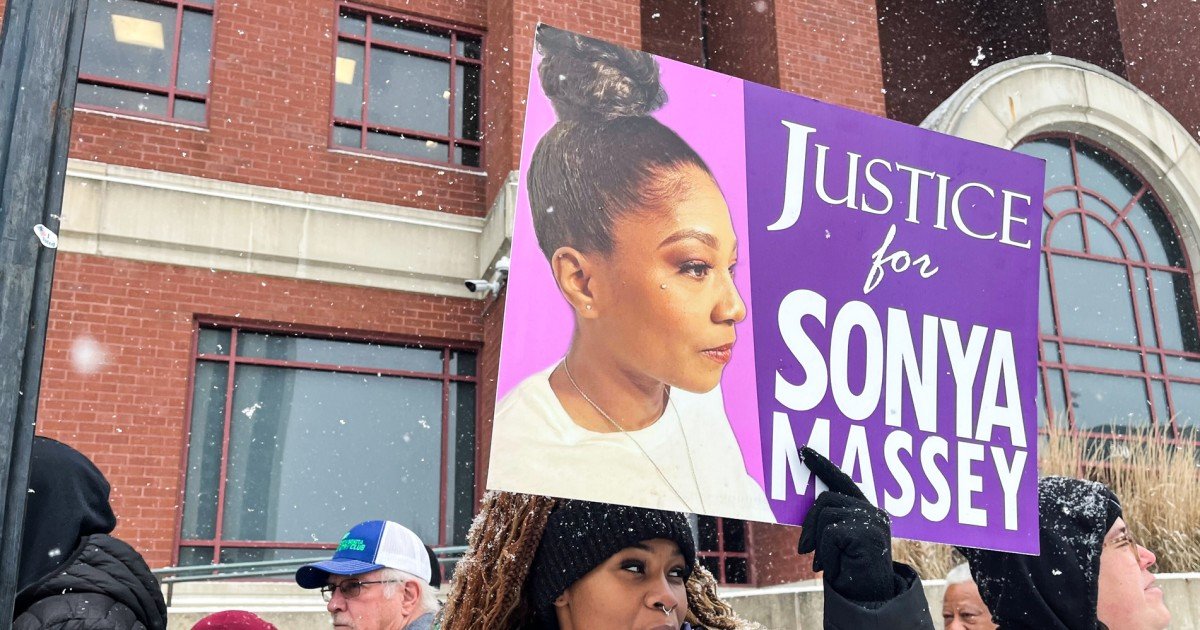
Massey’s murder triggered a national response, sparking protests across the country. Protesters gathered outside the courthouse on Monday to demand justice for Massey, who had mental health issues, according to his family.
His death raised new questions about the shootings of Black people in their homes by law enforcement in the United States and prompted a change in Illinois law requiring greater transparency about the backgrounds of candidates for police jobs.
The prosecution’s first witness, an Illinois State Police officer who investigates officer-involved shootings, testified that he was called to document the scene but was shocked when he saw body camera footage in the days afterward.
“I just thought there had to be something more. Verbal threats, prolonged interactions, something that would have led to an interaction with deadly force,” Weston testified.
The trial is expected to last a week and a half.