


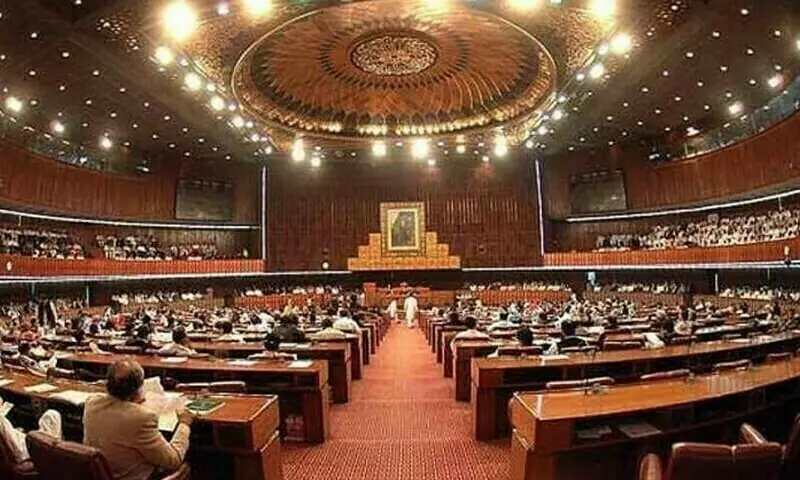
A joint session of Parliament on Tuesday passed the National Commission for Minorities Bill 2025 with some changes, which aims to establish a national body dedicated to protecting and promoting the rights of minority communities in Pakistan.
Law Minister Azam Nazeer Tarar introduced the bill amid protests by some members, particularly those belonging to the PTI and Jamiat Ulema-i-Islam—Fazl (JUI-F), and with National Assembly Speaker Ayaz Sadiq presiding over the session.
The bill was supported by 160 members and 79 voted against.
While the Minister of Justice presented the bill, several members openly opposed it. Given this, Tarar clarified that “neither the law nor the Constitution, nor our conscience allow us to make a proposal that contradicts the Quran and the Sunnah.”
He said four amendments were suggested to the original draft of the bill and had been incorporated into the proposed legislation.
Saying that minorities were defined as “non-Muslims” in the Constitution, he said: “This is a commission for non-Muslims. Our Hindu, Christian and Parsi brothers are as good Pakistanis as we are.”
The minister recalled that a 2014 Supreme Court ruling called for the constitution of a commission for minorities. The issue came to the joint session after about ten years, he added, before debate on the bill began.
During the debate, PTI chairman and MNA lawyer Gohar Ali Khan pointed out that the bill had come to the joint session after the speaker returned without giving his consent and with some objections.
The bill was referred to the president after it was passed separately by both houses of Parliament for approval. However, in late August, the presidency announced that a consensus had been reached on amendments to the bill, following which a revised version was finalized and sent to Parliament for reconsideration in a joint session.
“There should be a debate as to why the president did not consent to the bill,” Barrister Gohar said.
The PTI chairman also opposed section 35 of the bill, which was further elaborated by JUI-F senator Kamran Murtaza.
He said section 35 of the bill stated that the legislation would have overriding effect. This meant that as the most recent law, which would be the bill under consideration after its passage, it would have a preponderant effect over all previous legislation.
He said the provision should be omitted from the bill entirely.
In addition, he also objected to article 12 of the bill, which according to him gave suo motu powers to the commission to be established under the proposed legislation.
“On the one hand, you are taking away suo motu powers of the courts. And on the other hand, this power is being given to the commissions,” he said, apparently referring to the recent 27th Constitutional Amendment that restricted the power of the Supreme Court. suo motu powers.
If these two provisions were omitted, he said, “we could say that this [bill] “It’s acceptable.”
Senator Allama Raja Nasir Abbas also participated in the debate and stated that “today we are here to give some people their rights, to legislate so that they get more rights.”
He said that currently the biggest problem in Pakistan is the violation of civil and fundamental rights. “There is democracy, [and] you are presiding over a session where there is no opposition […] “It’s not a good sign.”
He said the opposition’s rights were being trampled. While he was voicing his grievances on this matter, National Assembly Speaker Ayaz Sadiq interrupted him and asked him to debate the bill.
At one point in the debate, the speaker also gave the floor to lawyer Gohar, who again called for debate on the objections raised by the president. He said that the president had pointed out that for the first time the term minorities was being defined; that the president and members of the future commission could only be removed in the way that the judges of the TS and the higher courts would do; the commission would be empowered to create its own positions and improve them when another commission had such powers; and that the commission was allowed to have a separate account.
The President finally presented the bill before the joint session for voting, and the bill was subsequently passed by Parliament with the changes suggested by Senator Murtaza.
Under Article 75(2) of the Constitution, the legislation will now be returned to the President for approval. The provision states that “the president will give his consent within ten days, otherwise it will be considered given.”
The Human Rights Commission of Pakistan welcomed the passage of the bill in principle in a post on X.
“Noting that the legislative debate and amendments reflected some political friction, we intend to review the bill closely, but emphasize that the proposed commission must protect all religious minorities equally, without exception or hierarchy,” the human rights group wrote.
“Furthermore, its mandate and powers must be strictly aligned with the constitutional guarantees of freedom of religion or belief and non-discrimination for all minority citizens.”
Additional information by Iftikhar Khan