



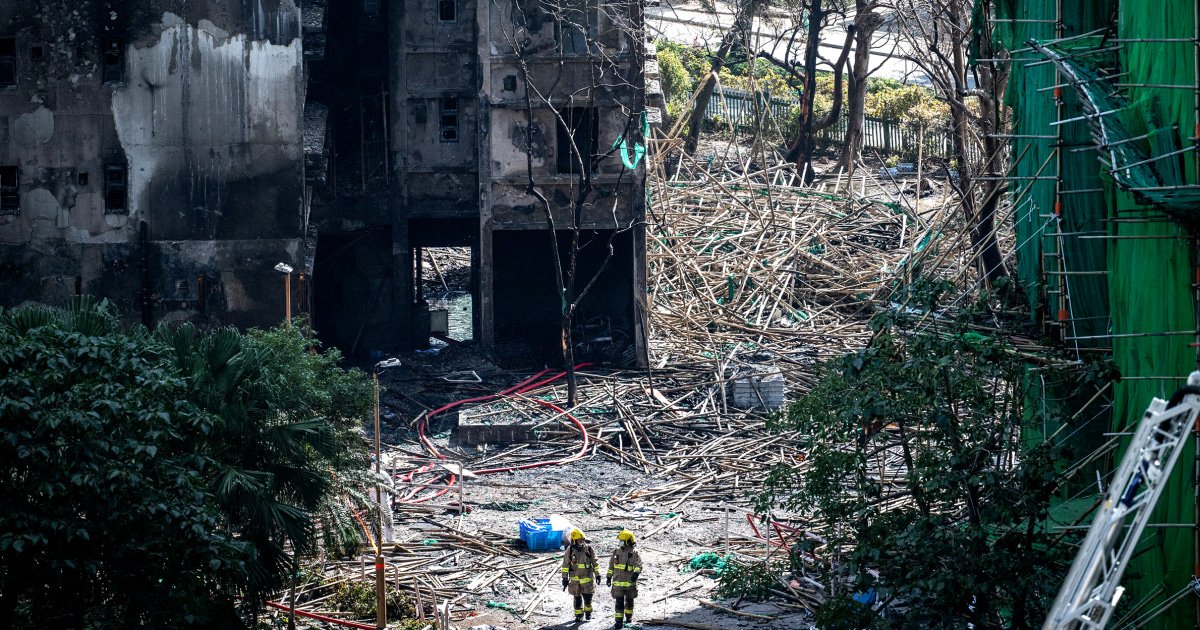
The death toll rose to 159 on Wednesday after police finished searching the seven high-rise towers that were engulfed in flames that took 40 hours to put out, authorities said.
The fire sparked grief, anger and fear in the densely populated city of 7.5 million people, which returned to China from British colonial rule in 1997.
“I think this case goes to the very heart of Hong Kong,” said John Burns, professor emeritus of politics and public administration at the University of Hong Kong. “And one of the reasons is that we all live in buildings like this. This could happen to any of us.”
Authorities have been conducting inspections at construction sites around the city and said Wednesday that mesh nets would be removed from 200 buildings by Saturday.
For Beijing, the fire risks becoming “a threat to national security, a threat to stability, and that is why they have taken the measures they have taken,” Burns said.
The Hong Kong government issued its own warning on Wednesday against unnamed “destabilizing and anti-China forces,” accusing them of spreading misinformation and “distributing seditious pamphlets.”
A spokesperson said “any malicious defamation” directed at the government or rescue personnel would not be tolerated, “in particular criminal acts aimed at inciting hatred against the government.”
Wang Fuk’s court housed about 4,600 people, about a third of them over 65 years old. The ages of those killed ranged from 1 to 97, authorities said.
Residents of the only unaffected tower were briefly allowed to return to their homes on Wednesday and Thursday to pack their belongings while the investigation continues.
John Lee, Hong Kong’s top leader, said Tuesday that an independent committee headed by a judge would investigate the cause of the fire and that those responsible would be held accountable “regardless of who it is.”
He said the investigation would examine “issues of corruption, bid rigging and irregular tendering in building maintenance projects”, as well as the installation and operation of fire safety systems, and that the results would be made public.
“We will reform the entire building renovation system to ensure that things like this don’t happen again,” Lee told reporters.

The city’s anti-corruption body is already conducting a separate investigation.
So far, fifteen people from different construction companies have been arrested on suspicion of homicide. This week, police also arrested six people from a registered fire services installation contractor on suspicion of fraud.
Lee did not address reports that at least three people have been arrested by the national security police since the weekend for their criticism of the government, but said he would not tolerate any crime that “takes advantage of the tragedy.”
Kenneth Cheung, a former district councilor who was arrested after publicly criticizing the response to the fire, said in a social media post on Monday that he had been released on bail pending an investigation. He said in a separate post on Tuesday that he could not say more “as there is a gag order regarding the national security case.”
The other two reportedly arrested for alleged sedition were Miles Kwan, a university student who created an online petition calling for an independent investigation into the fire, and an unidentified volunteer who was handing out supplies to fire victims. Kwan was seen leaving a police station on Monday.
Hong Kong police did not comment directly when asked about the reported sedition arrests.
A year of complaints
Residents of Wang Fuk Court had complained for more than a year that the renovations posed a fire hazard, but their concerns were dismissed.
The Labor Department said it had conducted 16 investigations of the property since renovations began in July 2024. During that time, the department issued six notices and initiated three prosecutions, it said in a statement, which did not provide details.

During the most recent inspection, conducted on Nov. 20, less than a week before the fire, the department again warned the contractor to take appropriate fire prevention measures, although it said it did not find any problems that warranted prosecution.
Hong Kong observed a three-day official mourning period from Saturday to Monday, with 18 locations set up across the city for mourners to sign condolence books.
In Tai Po, the air around Wang Fuk Court still smelled of burning on Monday, five days after the fire. Despite the hundreds of people gathered around a de facto monument, a silence hung in the air, broken only by the singing of birds as the sun set.
Mourners, many of them teary-eyed, gently laid white lilies in a circle on a grassy area that had once been a rest area for the estate’s residents.
“There is a spirit of helping each other and taking care of each other,” said Hebbe Chan, a 20-year-old college student who had come to pay her respects.
“Only after arriving at the scene today did I begin to feel a kind of sadness, to feel that this fire had really taken away so, so much,” he said.