



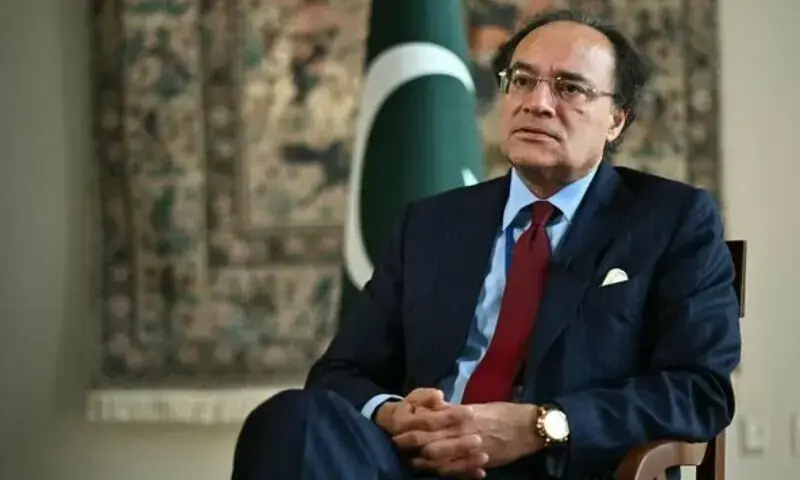
Finance Minister Muhammad Aurangzeb said on Wednesday that uncontrolled population growth and climate change are preventing Pakistan from becoming a $3 trillion economy.
Pakistan is home to a vast population of more than 251 million, according to World Bank figures. In 2023, the population growth rate was reported to have reached around 2.55 percent. However, nearly 45 percent of Pakistan’s population lives below the poverty line, according to a World Bank report.
At the same time, Pakistan has been ranked as the most vulnerable country to climate change in 2022, according to the Global Climate Risk Index 2025.
“I have made it clear from the beginning that we have two existential problems because if we do not address them correctly… there are two reasons that could prevent us from becoming a three trillion dollar economy and they are climate change and population growth,” the finance minister said in an interview on Geographic news program ‘Capital Talk’.
Aurangzeb said the former was no longer simply “an academic discussion” but something “we live with day in and day out,” pointing to the start of the smog season in Lahore and the recent floods that devastated large swaths of Pakistan.
The finance czar said the frequency and intensity of extreme weather events were increasing, adding that he had participated in three forums in the past week that discussed the issue of climate change.
“There is no way to value the precious human lives we have lost,” he said of deaths in recent floods and climate disasters in general, adding that the growth target for this year was set at 4.2 percent, but “now there is no doubt that it will be reduced by at least 0.4 to 0.5 percent.”
He stated that 80% of the damage caused by the recent floods occurred in Punjab and predominantly affected the agricultural sector, especially rice and cotton producing regions.
Regarding government measures to mitigate the effects of climate change, the Finance Minister said Prime Minister Shehbaz Sharif tasked Climate Change Minister Musadik Malik to draw up a plan for the next 300 days.
Multinationals leave Pakistan
When asked about the recent high-profile exits of multinational companies from the country, Aurangzeb said the issue was multi-faceted.
“These global companies make decisions about their involvement with respect to which customers to stay with, what products to stay with, and which countries to stay in.”
Citing his own past example, he pointed to the Royal Bank of Scotland’s exit from Pakistan, adding that the bank had decided at that time to exit all global money markets.
He further said that while some companies were exiting, others entered the market over the past three or four years, pointing to Aramco and others.
There has been a flurry of announcements in recent years by several multinational corporations exiting Pakistan or significantly reducing their operations here. Some of the notable ones include Procter & Gamble, Shell, Caltex and Eli Lily, among others.
There has also been a significant slowdown in manufacturing activity, where more than half of the products tracked by the Pakistan Bureau of Statistics through the Large Scale Manufacturing index have exhibited an average drop in production of 10% annually over the past two years.
Stability but no growth due to lack of reforms: Miftah Ismail
Meanwhile, speaking in an interview on Geographic news In the ‘Aaj Shahzeb Khanzada Kay Sath’ programme, former Finance Minister Miftah Ismail said that while stability was achieved, key reforms were needed for growth but were not carried out and instead the government had not reduced its expenditure but had increased taxes, which curbed demand.
He also pointed to the lack of reduction in the provinces’ share of the National Finance Commission award as a reason for the lack of growth.
The former finance minister also criticized the government’s expansion at the federal and provincial levels, saying: “If the government backs off a little, the private sector will take care of it.”
Ismail said there was a lack of incentives for foreign companies to enter the country due to its high taxes and gas and electricity utility costs. He added that the country’s entire energy infrastructure needed an overhaul to move to cheaper methods such as solar and wind.