


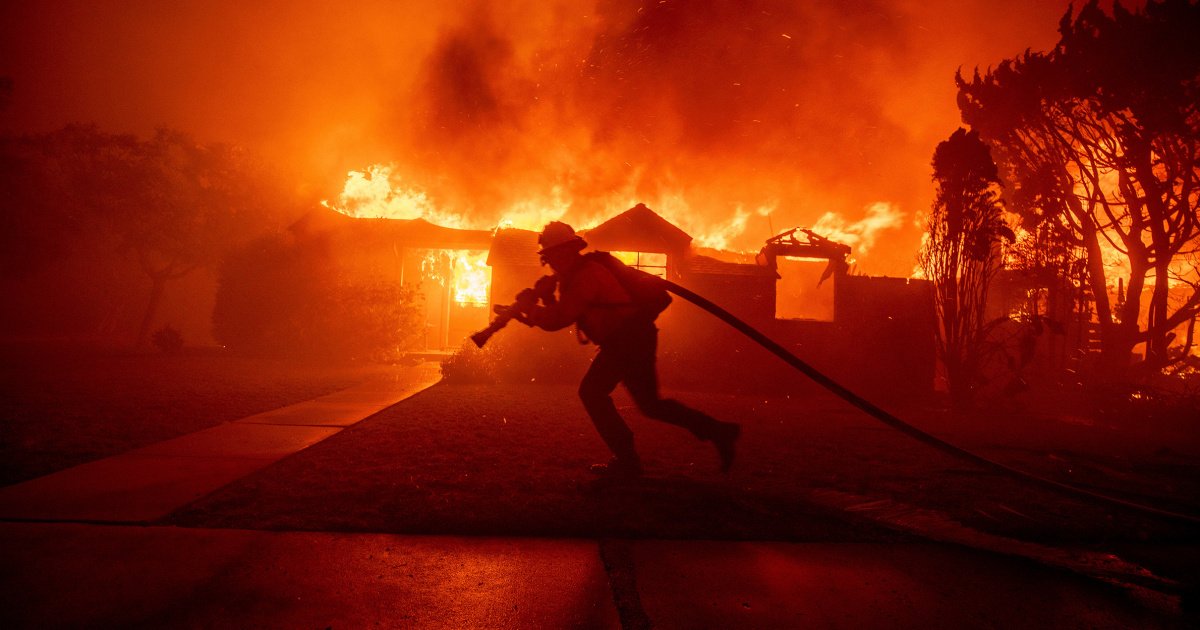
The key to identifying the cause of the still-devastating Palisades Fire lies at the top of a brush-covered hill where the fire broke out shortly after 10:30 a.m. Tuesday.
Fire investigators are still working to determine what sparked the inferno, but experts say it’s easy to rule out a common cause of wildfires: lightning. This week the region was storm-free. The area near Temescal Ridge Trail also appears to be free of power lines or transformers, ruling out another possible cause.
Follow live updates
That leaves the source of most wildfires: people. But was it the result of arson? Four experts interviewed by NBC News said it was a possibility, but they thought it was most likely that the fires were not set on purpose.
“This is what we call rugged, inaccessible terrain,” said Rick Crawford, former battalion chief of the Los Angeles Fire Department. “Arsonists generally don’t wander 500 feet from a trailhead through trees and brush, light a fire, and then flee.”
Fires break out constantly in the wooded areas outside Los Angeles, many of them unintentionally started by homeless people. Fires almost never turn into destructive flames due to the lack of strong winds. The combination of fierce winds and an arid landscape created ideal conditions for the fast-moving fires that have consumed large swaths of Los Angeles this week.
“You don’t need a gang of arsonists to go out and start fires because nature takes care of that for you,” said Scott Fischer, a retired federal law enforcement arson investigator.
“There are arsonists out there,” he added, “but is there a gang of arsonists running around Los Angeles right now? “It’s not likely.”
However, imitation arson is a known phenomenon. Experts said they wouldn’t be surprised if one of the smaller fires that broke out after the Palisades Fire was intentionally set.
“When a big fire like this happens As experienced in Los Angeles, sometimes you get people to go out and start a fire,” said Terry Taylor, a retired wildfire investigator who now works as an instructor. “It’s a thing of imitators. … It happens from time to time.”
Taylor and the other experts said those answers are unlikely to come soon, since determining arson tends to require a lengthy investigation.
Fire Eaton
The Eaton fire, the second largest to wreak havoc in Los Angeles, is not one likely to have been started by an arsonist, experts say. It exploded Tuesday night in an area east of Altadena where a series of high-voltage transmission lines fly overhead.

Given the area and weather conditions, fire experts said the first thing they thought of was power lines. Strong winds can cause the lines to collide with each other, throwing up small balls of superhot molten metal.
“If the ground is really dry and the wind blows and poof, there’s a fire,” said Ed Nordskog, a retired Los Angeles County Sheriff’s Department detective who spent his career investigating arsonists.
But that’s just one potential scenario. It’s also possible that it was started by a person operating a camping stove, car or lawnmower that ejected a hot spark onto dry grass, Nordskog said.
As for the possibility that it was set intentionally, Nordskog said it was unlikely.
“Most of the time, these fires are not arson,” he said. “There is no data to support that the winds caused the appearance of arsonists.”
‘Inch by inch’
According to experts, identifying the cause of a fire is a laborious and highly specialized task.
The first step is to point out where you started. Things like burn patterns and charred debris can provide crucial clues.
Next comes the most detailed and laborious part of the process. Investigators will place a grid on the scene, usually with a rope, and literally crawl on their hands and knees looking for footprints or other clues.
Investigators often use metal detectors and magnifying glasses or even binoculars to aid in the search.
“They will advance inch by inch and it will take hours,” Nordskog said. “It’s not fun.”
In the case of the Eaton fire, investigators will likely use magnets to help them look for small pieces of molten metal that could have been dislodged by power lines if they had collided. But the existence of the metal doesn’t necessarily indicate that’s how the fire started, Nordskog said.
“Whether the spark from the power lines was due to things already on fire or what started the fire has yet to be determined,” he said. “There are so many things that happen in an investigation, so many factors. “If someone tells you right away what caused the fire, they must have seen it.”
If investigators find evidence that the fire was caused by a person, they must work to determine whether it was the result of an accident, negligence, or an intentional act.
John Abatzoglou, a professor of climatology at the University of California, Merced, examined 30 years of government data on fires in Los Angeles County. It showed that the most common causes of wildfires between 1992 and 2020 were mishaps involving vehicles and other equipment.
“Over 95% of these are human-caused fires,” he wrote in an email. “Arson is among the causes, but most man-made fires are unintentional.”
“The best players there are”
The prospect of arsonists burning down Los Angeles gained traction on social media Thursday when a group of people in Woodland Hills detained a man they suspected of starting a trash fire. The man was arrested, but there was not enough probable cause to charge him with arson, police officials said Friday. Instead, he was arrested on a felony charge of violation of probation.
In addition to the Palisades and Eaton fires, four others have burned in Los Angeles. The causes remain under investigation.
A police task force has been set up to find out what caused the fires. The local agencies involved — the Los Angeles Fire Department, the county Police Department and Sheriff’s Department, as well as Cal Fire — are considered to be among the most capable in the country. The Bureau of Alcohol, Tobacco, Firearms and Explosives is leading the investigation.
“Everything is absolutely on the table,” Los Angeles County Sheriff Robert Luna said at a news conference Saturday.
It could take investigators several days to determine the causes of the fires. Determining whether a fire started by a person is a criminal act could take several months or even years, experts said.
As the number of fire deaths has reached 16, the effort to uncover the causes is expected to continue for as long as necessary.
“You’ll have the best players to be able to solve the problem,” said Crawford, the retired Los Angeles battalion chief.