



Listen to this article
4 minutes estimated
The audio version of this article is generated using text-to-speech, a technology based on artificial intelligence.
Two Alberta cabinet ministers say money was a key factor in the government’s decision to use the Charter’s notwithstanding clause to override teachers’ rights and end a province-wide strike.
In a November letter to constituents, Infrastructure Minister Martin Long said the United Conservative Party government could not risk allowing the labor dispute to go to arbitration and put the province at risk of paying hundreds of millions of dollars.
“An arbitrator would likely have sought a middle ground between the two proposals, leaving taxpayers with hundreds of millions, potentially billions, in additional costs,” he wrote.
“Albertans elected this government to make responsible decisions, not delegate them,” the letter said.
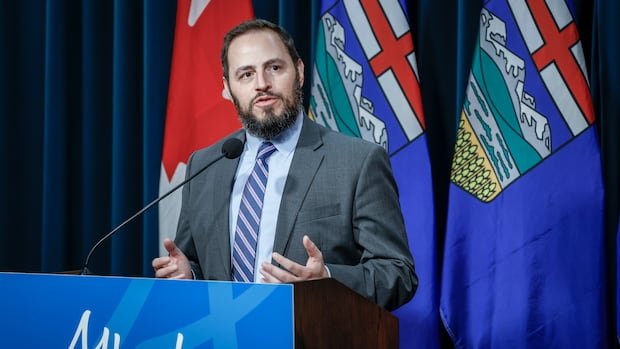
Education Minister Demetrios Nicolaides, asked by reporters Wednesday about Long’s letter and its potential costs, said elected leaders, not third parties, need final approval for decisions with major political and financial implications.
He said that in this circumstance, the government was facing an impact “in the order of billions of dollars” and changes to government classroom management policies.
“I firmly believe that those final decisions should be in the hands of elected officials and not independent, unelected arbiters,” he said.
Premier Danielle Smith’s government used the notwithstanding clause to avoid legal challenges to an October bill that ended a three-week teachers’ strike across the province.
At the time, Smith linked the decision to use the clause to the health of students, saying the mental, social and educational well-being of children in the classroom was threatened by the prolonged strike.
Alberta Teachers’ Association president Jason Schilling called the statements from both ministers “pretty disturbing” and said Long’s letter is effectively an admission by the government that the education system is underfunded.
“Were you worried about having to spend money on public education here? [because] “Would an arbitrator take the side of the teachers?” he said in an interview Wednesday.

Provincial governments have invoked the notwithstanding clause to protect laws that critics say infringe on Charter rights and freedoms. But what exactly is it?
During the strike, Smith said he believed in the negotiation process, but Schilling said Long’s letter “suggests the opposite: that arbitration is not a legitimate procedure.”
“It should be quite concerning for the labor movement in Alberta, but also in Canada,” he said.
In the midst of the strike, the two sides had contract proposals about $2 billion apart, and in mid-October, teachers rejected a government offer to end the strike and go through enhanced mediation.
At the time, Schilling said the proposal vetoed discussion of limits on classroom sizes, one of the main sticking points in the dispute.
In a statement Wednesday to The Canadian Press, Long reiterated that his top priority was getting kids back in the classroom as quickly as possible.
He also noted that the province’s now estimated $6.4 billion deficit prevents the government from spending “months on arbitration” and potentially “billions more” without avoiding the possibility of future teacher job disruptions at the local level.
NDP Opposition Leader Naheed Nenshi said the letter is an acknowledgment that the government does not believe in arbitration or the constitutional right to collective bargaining.
“The government has admitted today that it conspired to use the notwithstanding clause to pass an unconstitutional law because it wants to keep our education spending the lowest in the country.”
Nicolaides, however, defended the UCP’s record, saying that the cumulative increase in education funding over the course of the last two years has been almost 12 percent.
“We have been moving aggressively to approve and build new schools,” he said.
“[We’ve] increased funding and I am confident Albertans will see the results of these important investments and actions.”