


The provincial government is proposing sweeping changes to citizen-led referendum questions that could end an active court case over whether it is constitutional to ask Albertans whether they agree to secede from Canada.
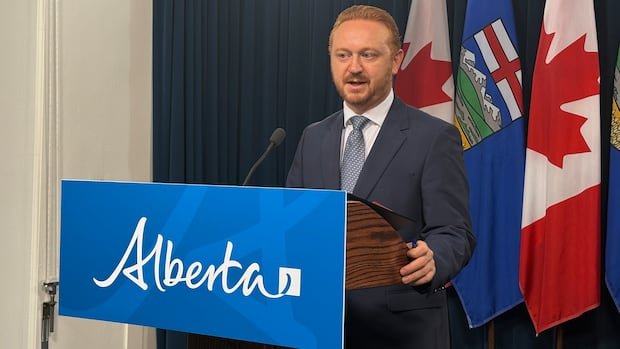
Bill 14, introduced Thursday by Justice Minister Mickey Amery, transfers powers from the chief electoral officer to the minister in deciding whether citizen petition initiatives should proceed.
It also includes an amendment to suspend any judicial proceedings initiated by the electoral director.
The legislation comes just weeks after King’s Bench Judge Colin Feasby heard arguments on an issue that chief electoral officer Gordon McClure referred to the courts, seeking an opinion on its constitutionality. The judge’s decision is supposed to be issued in the coming weeks.
Amery said the changes are intended to create a “permissive environment” for Albertans trying to raise referendum issues.
He said the court case currently underway “may or may not continue.”
“The reality is that the court has the right to make a decision on any question brought before it, regardless of what we are doing here.”
If Bill 14 is passed, only the minister could refer a citizen referendum issue to the courts. That power currently resides with the electoral director. The minister could also recommend changes to a constitutional referendum question before putting it to voters.
Additionally, the legislation proposes amendments to restrict the names political parties can use, limit some of the powers of the province’s legal regulator and implement government oversight over a non-profit organization that distributes grants for legal education and justice work.
Alberta NDP deputy leader Rakhi Pancholi said Thursday the opposition will “fiercely object” to the legislation.
“There are so many pieces here that are problematic and should be of deep concern to all Albertans,” he said.
“It appears that UCP Justice Minister Mickey Amery is quickly becoming the most powerful person in Alberta. Because he has given himself an incredible amount of authority.”
Future of the court case on the referendum issue
Lawyer Jeffrey Rath represents Alberta Prosperity Project executive Mitch Sylvestre, who is behind the potential referendum question that would ask Albertans if they agree that the province “will become a sovereign country and will be a province of Canada.”
Rath said in an interview that he believes the province is interfering in the current court case.
“I think they’re afraid that we’ll win and that a court will say that what we’re doing is perfectly fine and constitutional,” he said.
Lawyers involved in the case are due to appear in court one last time on Friday and then await a decision.
“The bill isn’t passed until it’s passed,” Rath said.
“Until the legislature says, ‘We don’t have a court case,’ we still have a court case.”
The Alberta Prosperity Project issued a statement Thursday afternoon, calling Bill 14 an “unintended gift to pro-independence Albertans” that will eliminate “red tape” that has stalled progress on the referendum issue.
The legislation also amends the Citizens’ Initiative Law to eliminate the provision that proposals cannot contravene the Constitution or exceed the jurisdiction of the legislature.
Any citizen initiative request that has not been issued at the time the modifications come into force will be annulled. But Bill 14 allows applicants to reapply within 30 days without paying another fee.
Elections Alberta has issued two citizen petitions: one asking whether Albertans agree the province should remain in Canada and another asking whether the province should stop allocating public funds to independent or private schools.
Changes in electoral rules.
Bill 14 also proposes to restrict the names of political parties, so that they will not be allowed to register using “a word or phrase associated with” another party.
There is still some discretion left for the chief electoral officer, but the bill contains a list of words and phrases that cannot be used. These include: conservative, advantageous, communist, democrat, green, pro-independence, liberal, pro-life, reformist, republican, solidarity and wild rose.
Amery said the changes are intended to stop efforts like the one that saw more than 200 candidates placed on the federal ballot for Battle River-Crowfoot this year.
“Some people want to confuse people into voting for them based on the name ‘conservative,’ but this is not a partisan issue,” he said.
“It would be no different than a party coming forward and seeking to register a name: ‘The Alberta Democrats’ or ‘The New Liberals’ or ‘The Greener Party.’ This is not what we want for the landscape here in Alberta.”
But the change will also affect two former United Conservative Party MPs, who left the party to run as independents and are now trying to re-register with the Alberta Progressive Conservative Party.
The amendments to the nomenclature rules, if approved, will apply retroactively until July 2025.
One of the MLAs, Peter Guthrie, said it is “crazy” that the UCP government is preventing any other party from using the word “conservative”.
“[The premier] “knows and realizes how dangerous a moderate and fiscally conservative party is for them, and that is what we are,” he said.
“You can call us whatever you want: I don’t know, the Redacted Progressive Party? I don’t know what it’s going to be like, but we’ll go back to the drawing board to come up with something.”
Changes affecting Alberta’s legal community
The legislation also includes specific changes that would reduce the type of training the province’s legal regulator can require of lawyers.
The Law Society of Alberta will limit itself to requiring a law degree or certificate of qualification, a bar admission course, and training imposed as a result of disciplinary proceedings as mandatory education for practicing lawyers.
Any mandatory training must also meet the requirements of the government’s Regulated Professions Neutrality Act, which, among other changes, says regulators cannot require “cultural competency, unconscious bias, or diversity, equity and inclusion training.”
In 2023, a group of Alberta lawyers asked the law society to remove a rule that allows the regulator to require legal education on a mandatory Indigenous cultural competency course.
That effort was defeated and one of the lawyers involved, Roger Song, requested a judicial review of the decision. A judge dismissed the request in September.
Amendments to the province’s Legal Profession Act would also make the province’s attorney general (a role held by the minister of justice) immune from sanctions for actions he or she takes that are “part of his or her official duties.”

The NDP’s Pancholi questioned whether Amery is putting himself in a conflict of interest by introducing “a law granting immunity.”
Two former United Conservative Party justice ministers have faced court proceedings in recent years.
The complaint against lawyer Tyler Shandro arose from his time as Minister of Health. He was found not guilty of unprofessional conduct.
Kaycee Madu was reprimanded by the law society this year for a phone call she made to former Edmonton Police Chief Dale McFee shortly after receiving a traffic ticket in 2021.
Madu’s appeal against that decision is scheduled for a hearing in February.
Bill 14 requires appeals from disciplinary decisions by law societies to be heard in the Court of King’s Bench, rather than a 24-member governing board made up of other lawyers known as Benchers.
The legislation would also give the Minister of Justice direct oversight over parts of the Alberta Law Foundation.
The foundation, a not-for-profit organization that has historically operated independently of the government, receives interest income from Alberta lawyers’ joint trust accounts, where client funds are held. That money is then distributed through grants to other organizations to support legal aid, access to justice initiatives, and legal education.
The changes in Bill 14 would give the Minister of Justice authority to impose, approve or reject the bylaws of the Alberta Law Foundation, and would require the bylaws to be subject to the minister’s directives.