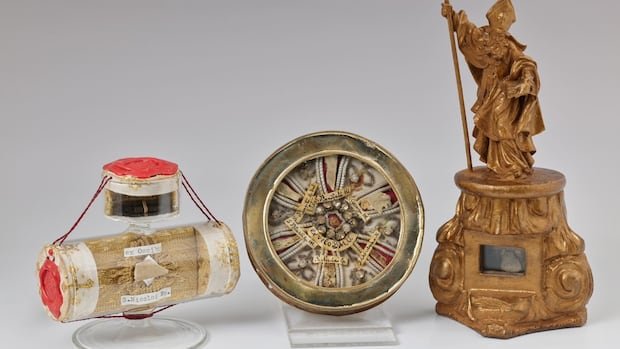
The relics Santos, including the relics of San Nicolás, who inspired Santa Claus, were confiscated by Canadian border services and returned to Italy after a Winnipeg man tried to import them illegally.
A brass and glass medallion, a wooden statuette that represents the saint and a glass tube that contained bone fragments, along with documents that prove the authenticity of the object, were returned to the Italian authorities on Wednesday, the Canadian government said in a press release.
The objects were intercepted in February and June 2020 after a man bought the reliquaries through eBay for a total of almost $ 3,300. Canada’s border officers who project messaging imports in Winnipeg believed that objects were foreign cultural property that may have violated the Export and Import Law of Cultural Properties.
The responsibility is in the concessionaire, the collector, the institution or the general public to obtain information related to import or export and comply with the procedures for objects that can be considered cultural property, said a spokesman for the Canada Border Services Agency in an email on Sunday.
The agency referred to the relices to be examined more thoroughly by the Federal Government Canadian Heritage Department, which included evaluations and expert consultations with the Italian authorities that confirmed that the relics were protected and must be returned.
In March 2021, the Attorney General of Canada ordered a motion for the three objects to recover to Italy, according to a judicial decision of the Federal Court Roger Lafrenière.
The court ruling determined that the man did not have an export permit or information about the authenticity of the reliquaries, who believed they were forgery that he planned to donate to his church.
It was required that the man pay the Attorney General of Canada more than $ 2,200 to cover the costs of the motion, the judicial decision said.
Tomb of the saint
The relics contain bone fragments of San Nicolás de Myra Who was born in the south of Türkiye during the third century, was chosen Bishop of Myra and dedicated his life to helping the less fortunate, according to the history shared by the Vatican.
He inspired the tradition of giving gifts in some European countries on the day of the saint’s party, since the children would leave socks or shoes on the eve of the party with the hope that they are filled with gifts in the dawn.
After his death, his grave in Myra became a place of pilgrimage. Most of their relics are now in a grave in the crypt of the Di San Nicola Basilica in Bari, Italy, where they have rested since 1087, According to the center of NicholasA virtual resource that shares information about Saint Nicholas.
The recovery of their relics brands the first time Canada returned cultural property to Italy, although Canada has returned cultural property to 14 different countries around the world as part of its promise under the UNESCO Convention of 1970, the federal government said.
Canada and Italy have mutual obligations under the legislation to help each other in the return of any cultural property that possesses an artistic, historical, archaeological or ethnoanthropological value that has been imported or exported illegally.
Canadian and Italian government officials and cultural heritage experts joined in an event on Wednesday to commemorate the return of the reliquaries and discuss strategies to combat crimes related to art, including illicit traffic and robbery.
Steven Guilbeault, Minister of Culture and Canadian identity, said that Canada is committed to strengthening international collaboration to combat these crimes that threaten the inheritance of a country, according to the statement.
The Italian ambassador to Canada, Alessandro Cattaneo, said that the return of objects is a leap forward for the associated countries.